When we look out at a lush, green backyard or a beautifully landscaped park, it is easy to assume that any thriving green space is a win for nature. However, underneath the surface of our modern landscapes lies a quiet crisis. Global insect populations are declining, bird species are losing their nesting grounds, and local food webs are fracturing.
For years, conservationists offered a straightforward solution: plant native plants. While this advice remains incredibly valuable, modern ecological science has revealed a deeper nuance. Not all native plants are created equal.
Enter keystone native plants—the botanical superstars that carry the weight of entire ecosystems on their shoulders. If you want your garden or community space to truly come alive with regional wildlife, understanding and planting these ecological powerhouses is the ultimate cheat code.
What is a Keystone Native Plant?
The term “keystone” comes from architecture. It refers to the wedge-shaped stone at the very peak of a masonry arch. While it might not look more important than the other stones, it holds the entire structure in place. If you pull out the keystone, the arch collapses.
In ecology, a keystone plant species functions exactly like that stone. Popularized by renowned entomologist Dr. Douglas Tallamy and his research team at the University of Delaware, keystone plants are native species that support a disproportionately large share of local wildlife relative to their abundance.
The Golden Ratio of Ecology: Dr. Tallamy’s research revealed a stunning statistic: just 14% of native plant species are responsible for producing 90% of the caterpillar food that drives terrestrial food webs. Furthermore, a mere 5% of native plants account for 75% of all caterpillar host resources.
If a landscape lacks these specific keystone genera, the local food web fails—even if the overall plant diversity is high.
The Crucial Link: Caterpillars, Specialist Bees, and Birds
To understand why keystone plants matter so much, we have to look closely at two specific groups of insects: caterpillars and pollen specialist bees.
1. Caterpillars: The Energy Currency of the Food Web
Most leaf-eating insects are dietary specialists. Over millions of years, they co-evolved with specific native plants, developing biochemical workarounds to tolerate those plants’ unique chemical defenses. They cannot simply switch to eating an introduced ornamental plant like a Japanese barberry or a Bradford pear.
Why do caterpillars matter so much to wildlife lovers? Because they feed the birds. * An astonishing 96% of terrestrial bird species feed insects to their young.
-
Chicks cannot digest hard seeds or tough beetles; they require soft, protein-rich, carotenoid-packed caterpillars.
-
A single clutch of black-capped chickadees requires between 6,000 and 9,000 caterpillars to grow from hatching to fledging.
Without keystone plants to host those caterpillars, the birds in your neighborhood simply cannot reproduce successfully.
2. Pollen Specialist Bees
While generalist pollinators like honeybees can gather pollen from a wide variety of flowers, many of our native wild bees are specialists. They can only feed their larvae pollen from specific plant genera or families. If those plants are missing from the regional landscape, those specialist bee species vanish entirely.
The Heavy Hitters: Top Keystone Trees and Shrubs
If you are looking to maximize your ecological impact, starting with woody plants—trees and shrubs—provides the highest return on investment. They offer massive structural volume, meaning a single tree can provide thousands of square feet of foraging space for wildlife.
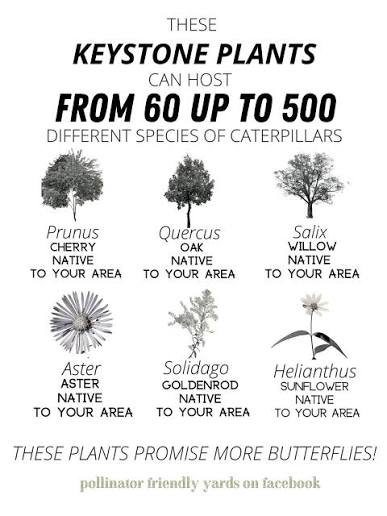
| Plant Genus | Common Name | Approximate Lepidoptera (Moth/Butterfly) Species Supported | Ecological Value |
| Quercus | Oaks | 400 – 900+ (depending on region) | The ultimate lifesaver. Supports more insects, acorns for mammals, and nesting cavities than almost any other tree. |
| Prunus | Cherries, Plums | 340 – 450+ | Spectacular spring blooms for early pollinators; highly nutritious fruit for migratory birds. |
| Salix | Willows | 300 – 450+ | Vital early-season nectar and pollen source for emerging queen bees; critical for riparian health. |
| Betula | Birches | 250 – 400+ | High-quality seeds for winter birds; textured bark provides overwintering sites for insects. |
| Vaccinium | Blueberries, Cranberries | 200 – 270+ | Exceptional double-duty plant: hosts hundreds of caterpillars and feeds specialist bees, while offering summer berries. |
The Mighty Oak (Quercus)
If you only have space to plant one thing, make it a native oak. Across almost every ecoregion in North America, oaks rank as the single most powerful keystone genus. They act as a massive biological engine, supporting everything from tiny canopy-dwelling caterpillars to woodboring beetles, owls, turkeys, squirrels, and deer.
Willows (Salix) and Cherries (Prunus)
These two genera are critical because of timing. Willows are often among the very first plants to wake up in the spring. Their catkins provide an emergency lifeline of pollen and nectar for native bumblebee queens emerging from hibernation. Cherries follow closely behind, providing early foliage for hungry caterpillars and later offering rich berries that sustain songbirds through the summer.
The Meadow Powerhouses: Keystone Perennials
You don’t need acres of woodland to make a difference. Herbaceous perennials can easily fit into suburban yards, urban garden beds, and patio containers. By planting these specific flowering keystones, you turn your yard into a high-octane refueling station for butterflies, beneficial predatory wasps, and specialist bees.
1. Goldenrods (Solidago)
-
Caterpillar Host Power: Supports over 100 species of moths and butterflies.
-
Specialist Bee Power: Supports dozens of pollen-specialist bee species.
-
The Myth: Goldenrods are often wrongly blamed for fall allergies. The true culprit is ragweed, which blooms at the same time but has wind-blown pollen. Goldenrod pollen is heavy and sticky, designed to be carried by insects, making it perfectly safe for allergy sufferers.
-
Seasonal Value: Goldenrods provide crucial late-season nectar that helps migrating Monarch butterflies fuel up for their long journey to Mexico.
2. Native Asters (Symphyotrichum)
-
Caterpillar Host Power: Supports over 100 species.
-
Wildlife Impact: Alongside goldenrods, asters dominate the late-summer and autumn landscape. When almost everything else has gone to seed, asters offer a crucial burst of pollen and nectar. Their dried winter seed heads are a favorite food source for goldfinches and native sparrows.
3. Native Sunflowers (Helianthus)
-
Specialist Bee Power: One of the absolute best genera for supporting specialist bees, with dozens of bee species relying strictly on their pollen.
-
Wildlife Impact: True native perennial sunflowers (distinct from the giant annual varieties grown for agricultural seed) spread beautifully, forming dense patches that offer excellent protective cover for small mammals and ground-nesting birds.
Knowing Your Ecoregion: Location is Key
A plant is only a keystone if it belongs in your specific geographic neighborhood. Ecology doesn’t look at political borders or state lines; instead, scientists categorize land into ecoregions—areas that share similar climates, soils, geology, and native plant communities.
The National Wildlife Federation (NWF) and organizations like Homegrown National Park break these down to ensure gardeners can choose the perfect local variants.
-
In the Eastern Temperate Forests: White Oaks (Quercus alba), New England Asters (Symphyotrichum novae-angliae), and Stiff Leaf Goldenrod (Solidago rigida) reign supreme.
-
In the Great Plains: You will look to tough, drought-tolerant keystones like Plains Coreopsis (Coreopsis tinctoria) and maximize native prairie grasses that shelter delicate butterfly chrysalises.
-
In the Western Cordillera / Mountain Regions: Native Willows (Salix), Quaking Aspen (Populus tremuloides), and Silvery Lupine (Lupinus argenteus) take center stage to support high-altitude pollinators.
Always cross-reference your zip code or ecoregion with native plant finders to ensure you are buying species that have co-evolved with your local wildlife.
How to Design a Landscape Using Keystone Plants
Transitioning your outdoor space into a wildlife haven doesn’t mean you have to let your yard go completely wild or draw complaints from the neighborhood association. It’s all about intentional design.
Layer Your Plantings
Mimic the structure of a natural forest or meadow edge by planting in vertical layers:
-
Canopy Layer: Large keystone trees (Oaks, Maples, Birches).
-
Understory Layer: Smaller trees and large shrubs (Cherries, Dogwoods, Serviceberries).
-
Shrub Layer: Nutritious, berry-producing keystones (Blueberries, Willows).
-
Herbaceous Layer: A dense tapestry of perennials (Asters, Goldenrods, Sunflowers, Milkweeds).
Practice the “Right Plant, Right Place” Rule
Assess your site conditions before buying. A swamp-loving Pussy Willow will struggle on a dry, rocky hillside, while a sun-loving prairie sunflower will fail to bloom in deep forest shade. Matching the plant to your soil type, moisture level, and sunlight availability ensures it thrives without the need for synthetic fertilizers or excessive watering.
Plant in Clusters
Instead of dotting a single aster here and a single goldenrod there, plant them in drifts or clusters of three to five. This makes it visually striking for human eyes and dramatically increases foraging efficiency for pollinators, who can easily spot and harvest from a dense target.
Leave the Leaves and Stalks
Many of the caterpillars hosted by your keystone trees drop to the ground to spin their cocoons in the leaf litter. If you rake, chop, and bag your leaves, you accidentally discard the very wildlife you worked so hard to feed. Keep a designated “soft landing” zone of mulch and fallen leaves directly beneath the canopy of your keystone trees.
Cultivating Hope: The Bigger Picture
It is easy to feel overwhelmed by global environmental news, but native plant gardening offers a tangible, powerful antidote to eco-anxiety.
By replacing even a portion of a sterile grass lawn with a thoughtful selection of regional keystone native plants, you are directly rebuilding a broken link in the ecological chain. You will quickly see the results of your labor: a flash of a yellow goldfinch pulling seeds from an aster, the mesmerizing transformation of a monarch chrysalis dangling from a milkweed stem, or the cheerful buzzing of native bumblebees at dawn.
We can no longer rely solely on remote national parks to preserve biodiversity. By planting keystones, we turn our own backyards, balconies, and school grounds into a collective green corridor—a living network that sustains our regional wildlife for generations to come.
