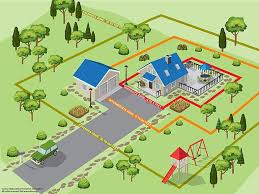
Designing Defensible Space: Advanced Firescaping Strategies for At-Risk Regions
As climate patterns shift and the wildland-urban interface (WUI) expands, catastrophic wildfires have transitioned from seasonal threats to year-round realities. For communities nestled in high-risk zones, traditional landscaping is no longer just a matter of aesthetics—it is a critical frontier of home defense.
Firescaping is the strategic design, installation, and maintenance of landscapes to minimize fire vulnerability. By understanding how fire moves and choosing the right layout and materials, property owners can create a resilient barrier that starves approaching flames of fuel and shields structures from intense radiant heat.
1. The Core Philosophy: Fuel, Connectivity, and the Home Ignition Zone
To design an effective firescape, one must first understand how a house catches fire. It rarely happens via a massive wall of flame rolling through the front yard. Instead, the vast majority of structural losses during a wildfire are caused by wind-borne embers (pyroclasts) that landing on combustible materials hours before or after the main fire front passes.
Firescaping addresses this by breaking up fuel continuity. In a standard landscape, plants create a continuous fuse from the wilderness directly to the porch. Firescaping breaks this fuse, utilizing the concept of the Home Ignition Zone (HIZ), originally developed by fire scientist Jack Cohen.
The HIZ divides the property into distinct, managed rings, each requiring a different level of fuel reduction.
2. Breaking Down the Firescape Zones
An effective firescape is structured into four primary concentric zones, starting from the structure and moving outward to the property boundary.
Zone 0: The Immediate Ember-Resistant Zone (0 to 5 Feet)
This is the most critical zone on the entire property. The goal here is simple: zero combustibles. If an ember lands within five feet of the house, there should be nothing for it to ignite.
-
Ground Cover: Replace wood mulch, bark chips, and organic ground covers with non-combustible alternatives such as decomposed granite, river rock, gravel, or concrete pavers.
-
Vegetation: Ideally, no plants should live in this zone. If foundation plantings are a must for architectural aesthetics, limit them to isolated, low-growing, high-moisture succulents (e.g., Agave or Sedum) kept meticulously pruned and free of dead leaves.
-
Structural Attachments: Keep firewood piles, wicker patio furniture, plastic garbage bins, and wooden tool sheds entirely out of this zone.
Zone 1: The Lean, Clean, and Green Zone (5 to 30 Feet)
This zone is designed to suppress fire intensity and prevent flames from directly touching the home or transferring intense radiant heat.
-
The “Lean” Concept: Keep vegetation sparse. Avoid dense, crowded clusters of trees or shrubs. Individual plants or small groupings should be isolated from one another.
-
The “Clean” Concept: Eliminate dead or dying vegetation. Rake up fallen leaves, pine needles, and twigs daily during fire season.
-
The “Green” Concept: Ensure all plants in this zone are well-irrigated and healthy. Lush, well-hydrated plants require significantly more energy to ignite than stressed, drought-parched flora.
-
Tree Spacing: Trees in Zone 1 should be spaced so that their mature crowns are at least 10 feet apart from one another and at least 10 feet away from any structure or roofline.
Zone 2: The Reduced Fuel Zone (30 to 100 Feet)
In this zone, the primary objective is to force a fast-moving crown fire down to the ground, where its flame length decreases and it becomes easier to manage or self-extinguish.
-
Vertical Mitigation (Limbing): Prune the lower branches of mature trees to a height of 6 to 10 feet from the ground. This eliminates “ladder fuels”—lower limbs and brush that allow a ground fire to climb up into the highly destructive forest canopy.
-
Horizontal Spacing: Create wide gaps between islands of shrubs and trees. On flat land, clusters of trees should maintain a minimum crown separation of 10 feet.
-
Slope Adjustments: Fire travels significantly faster uphill because the flames preheat the fuel ahead of them. If the property sits on a slope, increase the width of Zone 2 and double or triple the spacing requirements between trees and shrubs depending on the steepness.
Zone 3: The Extended Property Zone (100 to 200+ Feet)
For larger rural properties, Zone 3 acts as a buffer against the surrounding wildland.
-
Thin out dense thickets of wild brush.
-
Remove highly invasive, oily weeds (like mustard or cheatgrass) that dry out rapidly in summer and create highly flammable fuel beds.
-
Promote native, fire-resilient forest structures by favoring mature, thick-barked trees over dense, crowded undergrowth.
3. Plant Selection: “Fire-Resistant” vs. “Fireproof”
A critical rule of firescaping is that no plant is entirely fireproof. Given enough heat and drought stress, any organic matter will burn. However, plants possess drastically different levels of flammability based on their cellular structure, moisture retention capabilities, and chemical makeup.
Characteristics of High-Risk (Flammable) Plants
Avoid planting species that act as tinderboxes. Flammable plants often exhibit the following traits:
-
High content of volatile oils, resins, terpenes, or waxes (aromatic scents when leaves are crushed).
-
Accumulation of fine, dry, dead woody material inside the plant plant jacket.
-
Loose, papery, or shaggy bark.
-
Dry, needle-like or sword-like leaves.
Species to Avoid: Eucalyptus, Juniper (Juniperus), Cypress (Cupressus), Ornamental Pampas Grass, and volatile pines (like Monterey Pine). Junipers, in particular, are often dubbed “gasoline bushes” by firefighters due to their volatile resin content and dense internal dead twigs.
Characteristics of Fire-Resistant Plants
Fire-resistant flora typically acts as a heat sink, absorbing thermal energy without immediately bursting into flame. Look for:
-
High moisture content in leaves and stems (e.g., succulents).
-
Supple, broad leaves rather than narrow needles.
-
Little to no accumulation of dead wood or thatch.
-
Water-soluble, sap-based fluids rather than sticky resins or oils.
| Plant Type | Fire-Resistant Examples | Key Benefits |
| Groundcovers / Succulents | Sedum spp., Delosperma (Ice Plant), Agave | High water storage, low growth profile, prevents ember ignition on soil. |
| Perennials | Lavandula (Lavender), Salvia (Sage), Achillea (Yarrow) | Low-growing fuel mass; responds well to seasonal pruning. |
| Shrubs | Ceanothus (California Lilac), Rhamnus (Coffeeberry), Cotoneaster | Deep root systems for slope stability, lacks high resin content. |
| Deciduous Trees | Acer (Maple), Quercus (Oak – native varieties), Populus (Quaking Aspen) | High leaf moisture; drops leaves annually preventing permanent fuel build-up. |
4. Hardscaping as a Tactical Firebreak
Hardscaping—the structural, non-living components of a landscape—is the unsung hero of firescaping. When designed correctly, hardscape features act as literal fuel breaks, disrupting the path of a fire and giving defensive crews a safe perimeter from which to work.
Driveways and Walkways
Wide, concrete, asphalt, or interlocking stone driveways serve a dual purpose. They act as massive, non-combustible fuel breaks directly in front of or around structures, and they provide safe egress and access routes for emergency vehicles. Walkways wrapping around the home perimeter can effortlessly double as Zone 0 boundaries.
Retaining Walls
In hilly topography, masonry, stone, or poured-concrete retaining walls are invaluable. Not only do they prevent soil erosion, but they also deflect radiant heat and disrupt the upward convective flow of superheated gases, slowing down a fire’s uphill race.
Strategic Decks and Patios
Traditional wooden decks are highly vulnerable to embers drifting into the gaps between planks. Homeowners in at-risk regions should opt for non-combustible or fire-rated composite materials. Wrapping the underside of raised decks with fire-resistant soffits or heavy-duty wire mesh (less than 1/8-inch openings) prevents flying embers from blowing underneath and igniting hidden leaf litter.
5. Smart Irrigation and Maintenance Architecture
The greenest, most scientifically selected firescape will fail if it is abandoned to dry out. Water management is a fundamental pillar of keeping vegetation fire-resistant during peak fire season.
Drip Irrigation vs. Overhead Microsprayers
While sub-surface drip irrigation is highly efficient for water conservation, low-volume overhead microsprayers can be highly effective in Zone 1 during an active red-flag warning. They raise the ambient relative humidity directly around the plants and dampen foliage, rendering it less susceptible to spot fires started by rogue embers.
Greywater Systems and Rainwater Harvesting
In drought-prone areas, keeping a landscape lush using municipal water can be prohibitively expensive or legally restricted. Utilizing domestic greywater systems (diverting water from washing machines and showers to the landscape) ensures that Zone 1 vegetation remains highly hydrated even during severe water rationing.
6. The Essential Seasonal Checklist
Firescaping is not a one-and-done project; it is an ongoing partnership with the landscape. A property must change with the seasons to maintain its defensive posture.
-
Late Winter / Early Spring: Perform structural pruning. Remove lower limbs of trees, thin out dense brush canopies, and eliminate frost-damaged deadwood.
-
Late Spring: Clear out winter debris. Clean roofs, rain gutters, and valleys of accumulated pine needles and dried leaves. Mow annual grasses down to a maximum height of 4 inches before they turn brown and dry.
-
Summer (Fire Season): Monitor irrigation systems for leaks or blocked emitters. Keep a strict eye on Zone 0, ensuring no blown leaves or wind-blown debris pile up against the home’s siding or under steps.
-
Autumn: Continue clearing leaf drop. Ensure all firewood split for the coming winter is stored safely in Zone 2 or inside an enclosed, fire-rated structure, rather than stacked against the home.
Conclusion: A Paradigm Shift in Landscape Aesthetics
Firescaping does not mean stripping a property down to bare, uninviting concrete or creating a sterile, barren wasteland. Rather, it offers a sophisticated, modern aesthetic that blends ecology with engineering. By incorporating rich textures of stone, open pathways, artistic groupings of lush, drought-tolerant flora, and wide-open vistas, homeowners can curate a stunning landscape that honors the local environment while actively safeguarding their most valuable assets.
In at-risk regions, an intelligently designed landscape is the ultimate investment—proving that beauty and absolute resilience can live hand-in-hand.
